
Availability moved
Capacity, sellers, and eligible instruments could change before treasury completed its review.

A lean treasury team received substantial, recurring cash inflows—but the speed of daily operations made it difficult to evaluate every eligible rate, maturity, counterparty, and liquidity constraint. ATLAS.X turned the company’s investment policy and live opportunity set into an actionable allocation strategy.
The company regularly received large cash amounts and relied on short-duration products to protect liquidity while earning a return. Its small treasury team also managed cash positioning, funding, payments, exceptions, reconciliations, and the daily close.
When the operating day became hectic, the team often selected the most accessible eligible product or the most attractive rate immediately visible. At other times, cash remained idle while the team determined how much could safely be invested.
Capacity, sellers, and eligible instruments could change before treasury completed its review.
The highest displayed rate was not always the strongest decision after liquidity and maturity were considered.
Only approved instruments and four or five trusted counterparties could be considered.
Cash could remain uninvested—or earn a weaker rate—because the team lacked time to calculate every alternative.
An older cockpit may still keep an aircraft in the air. But integrated instruments, automated warnings, and coordinated procedures give the crew more time to understand the environment and act before conditions change.
A treasury office can also continue operating while cash sits idle or earns a suboptimal rate. The absence of a visible failure does not mean the financial position is being used efficiently. The organization may be missing potential gains simply because its team does not have the time, mobility, or analytical capacity to continuously compare every eligible investment decision.
Lexington connected ATLAS.X to the company’s cash position and investment portals. The platform evaluated live opportunities against internal rules, projected liquidity, and counterparty limits—then produced a ranked allocation for treasury review.
Separate required operating liquidity from cash that can be deployed without weakening the company’s daily position.
Balances · Forecasts · Reserves · ObligationsReceive current rates, capacity, maturities, sellers, settlement terms, and liquidity conditions from connected portals.
Rate · Term · Capacity · AvailabilityRemove products or counterparties that do not satisfy the company’s policies, limits, ratings, or liquidity rules.
Counterparty · Concentration · Maturity · LiquidityRank compliant combinations by eligible return while preserving liquidity and showing the reasoning behind each recommendation.
Allocation · Expected yield · Residual cash · EvidenceATLAS.X evaluated instruments as part of one portfolio decision—not as isolated quotes. Every recommendation considered how the allocation affected liquidity, maturity, concentration, and the cash required for future operations.
Highly liquid options evaluated by availability, yield, settlement, and approved provider.
Eligible short-duration instruments assessed against maturity, counterparty, pricing, and capacity.
Rate and term opportunities aligned with projected cash needs and approved maturity windows.
Other approved placements considered when they strengthened yield without compromising access to cash.
The dashboard gave treasury one controlled view of investable cash, approved products, counterparty exposure, maturity, liquidity, available rates, and the recommended next action.
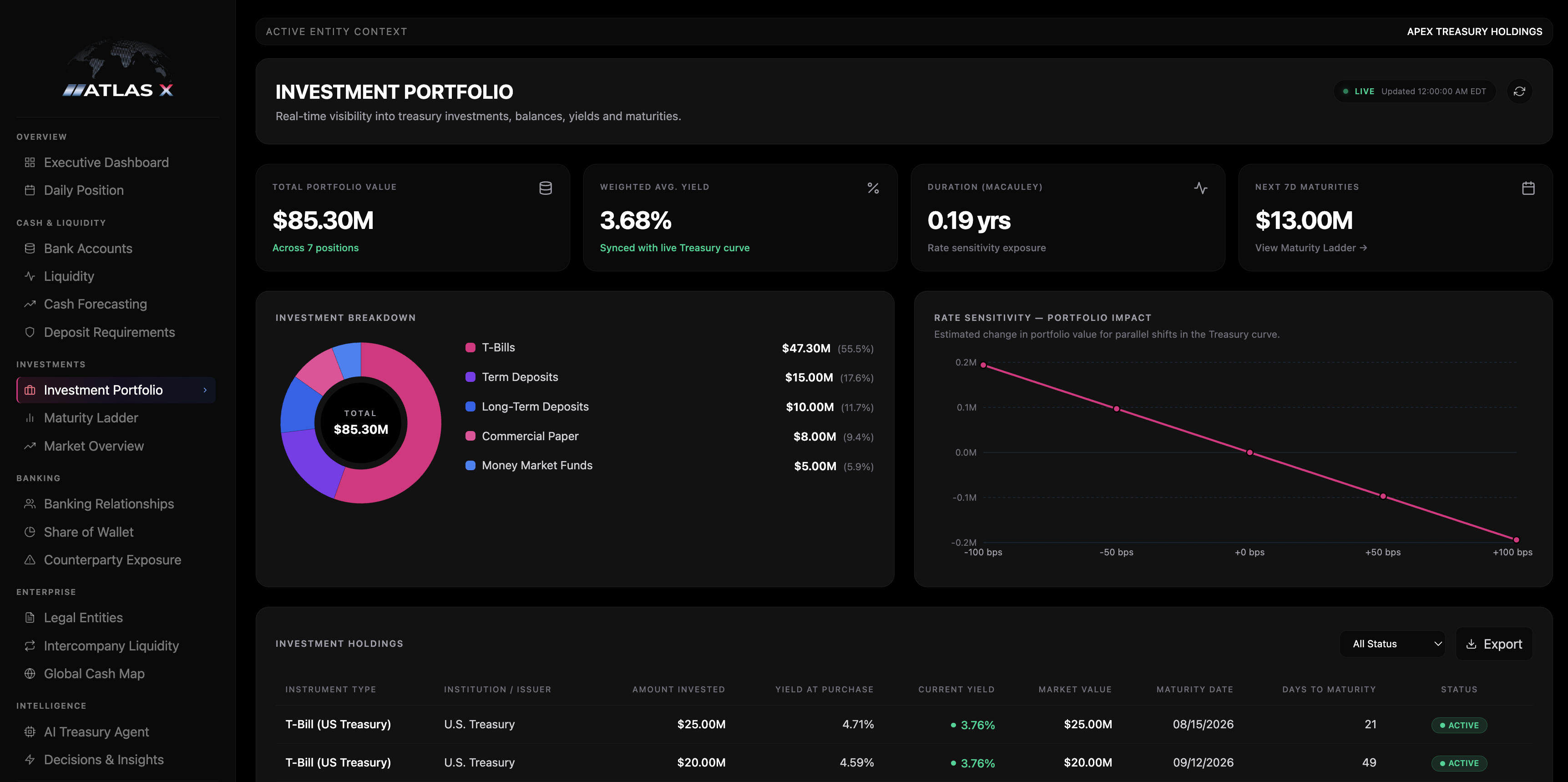
Treasury could review the proposed allocation, policy compliance, expected return, maturities, and remaining operating liquidity before authorizing execution.
The objective was not to chase yield. It was to stop leaving eligible yield unexplored.
ATLAS.X gave the company a faster, repeatable, policy-aligned process for recognizing idle liquidity, comparing approved opportunities, and presenting an optimized allocation while there was still time to act.
Turn fragmented opportunities into a controlled, explainable investment decision.