
Disconnected banks
Accounts and relationships were spread across institutions, portals, currencies, and regions.

A global company had moved its financial information to the cloud—but its banks, regions, procedures, and decisions still operated separately. Lexington integrated ATLAS.X to convert fragmented visibility into one synchronized treasury operating system.
The company had completed a cloud migration and had access to more financial information than ever. Yet information was inconsistent, bank connectivity was distributed across portals, and regional teams followed different processes.
Treasury still relied on legacy Excel checklists, manual follow-ups, and fragmented reporting. Front office, back office, and regional teams could each see part of the picture—but no one could see the complete financial position and the next required action at the same time.
Accounts and relationships were spread across institutions, portals, currencies, and regions.
Manual spreadsheets and individual checklists created delays, handoff risk, and uneven execution.
Cash shortages and overdraft exposure could become visible only after the opportunity to prevent them.
Existing dashboards showed data, but did not coordinate procedures or recommend the next treasury decision.
Older aircraft may continue to fly, but a modern cockpit connects instruments, procedures, alerts, and crew responsibilities into one coordinated operating environment. That integration strengthens situational awareness, improves execution, supports safety, and reduces avoidable operating cost.
Treasury is no different. Moving data to the cloud is like installing newer instruments without redesigning the cockpit. ATLAS.X connected the information, workflow, and decision process so the entire treasury team could operate from the same flight plan.
Lexington placed ATLAS.X above the company’s existing banks, cloud environment, reporting tools, and treasury systems—preserving those investments while adding the intelligence and orchestration layer the operating model was missing.
ATLAS.X organized balances, accounts, transactions, institutions, currencies, and regional structures into one governed treasury view.
Common definitions and classifications gave leadership a consistent view of cash, liquidity, investments, obligations, and intercompany movement.
Legacy Excel procedures became a controlled, step-by-step operating workflow with ownership, dependencies, status, escalation, and audit visibility.
Treasury intelligence identified emerging cash needs, concentration opportunities, investment options, and actions required before an exception became a loss.
ATLAS.X converted individual spreadsheets into an automated operating sequence. Every team could see what had been completed, what required review, who owned the next step, and which exceptions demanded immediate attention.
The interface brought the company’s global position, treasury workflow, exceptions, and recommended actions into a focused operating environment—giving every authorized team a common view without losing regional detail.
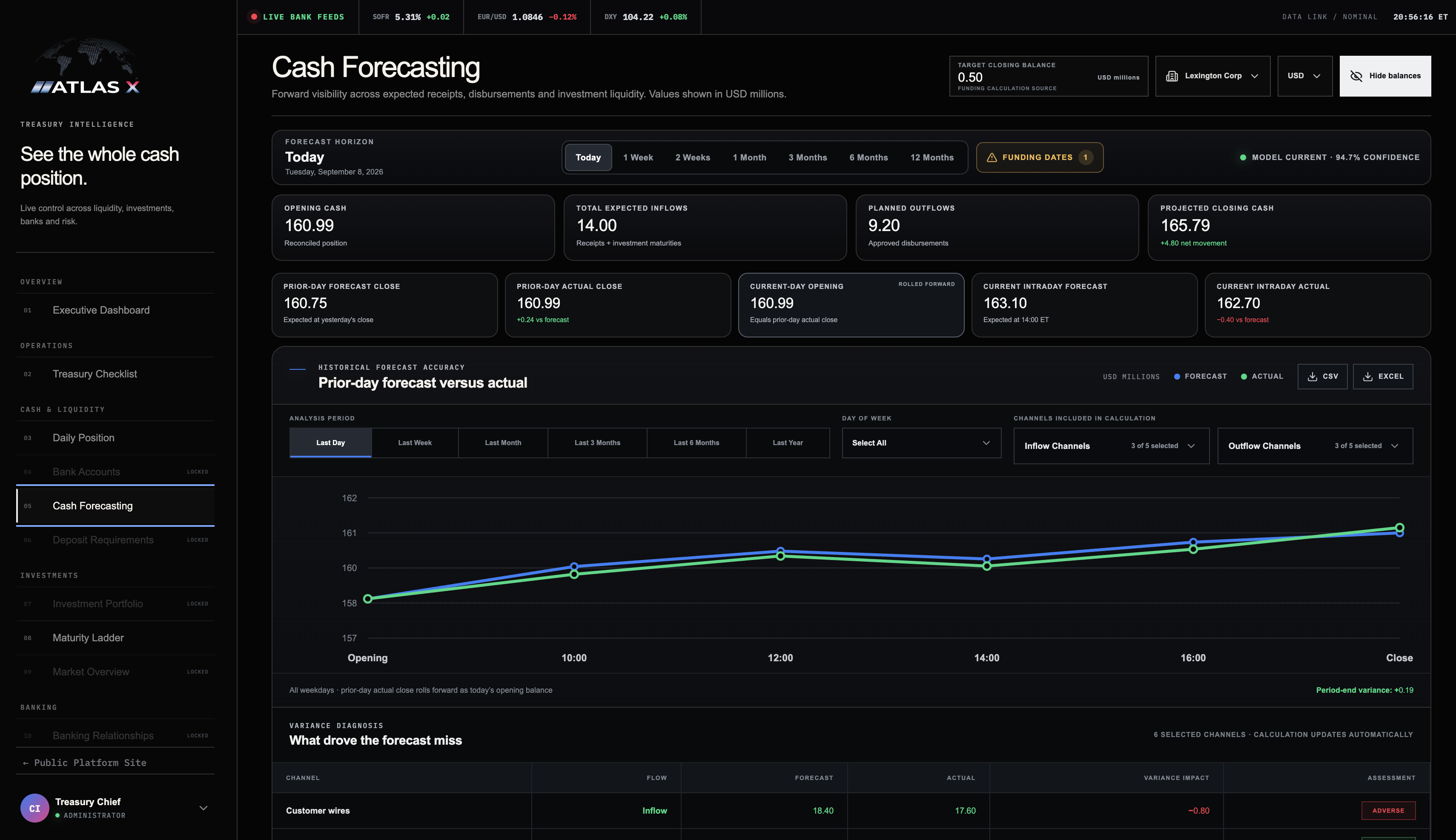
Balances, bank relationships, cash positioning, workflow status, and treasury priorities in one controlled environment.
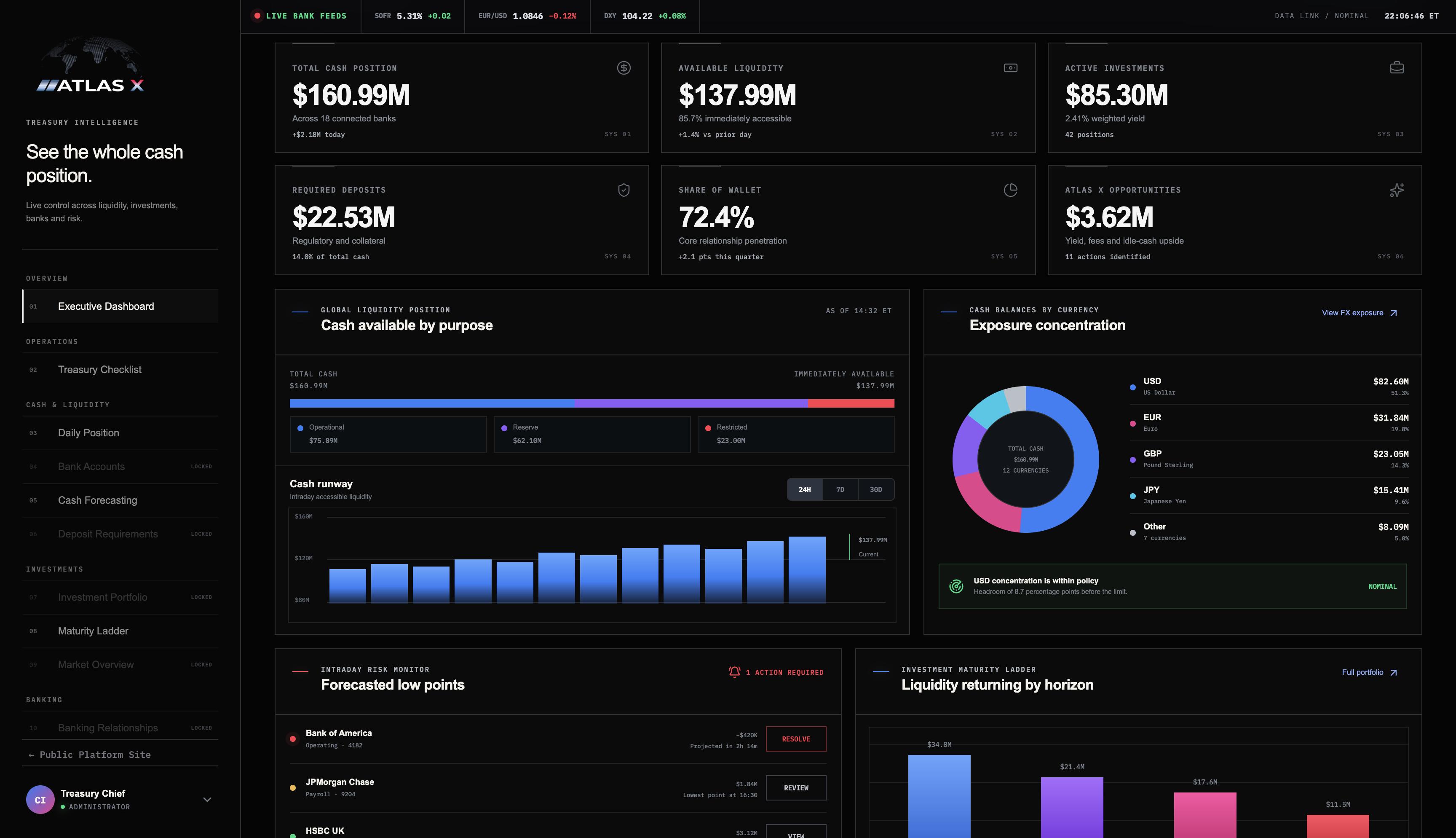
Decision-ready monitoring helped treasury recognize developing cash exceptions while there was still time to resolve them.
Consolidated visibility across banks, currencies, legal entities, and operating regions.
A clearer view of balances, activity, products, and relationship concentration by institution.
Visibility into fragmented liquidity and where cash could be brought together more effectively.
Decision support for excess cash, liquidity requirements, timing, and available investment capacity.
Early warning of potential shortfalls, overdrafts, and positioning issues before the day closes.
Contextual guidance that moves the team from observing an issue to coordinating its resolution.
An overdraft is no longer a problem we discover the next morning. It is a risk we can see and resolve before the day closes.
— Corporate Treasurer, global enterprise
The value of ATLAS.X was not another visualization layer. It was the ability to connect information, process, people, and decisions while there was still time to act.
Conventional BI remains valuable for visualization and reporting. The client’s challenge, however, required an operating layer that could connect treasury context, workflow, accountability, forecasting, alerts, and action—not charts alone.
ATLAS.X transformed a cloud-based but fragmented treasury environment into a connected decision system—giving leadership the visibility, procedure, and foresight required to act before risk became outcome.
Build your treasury cockpit